Biotin and Blood Tests: What the FDA Safety Communication Says

BLOOHAIR MEN contains 3,000 mcg of biotin per serving — 100 times the adult Adequate Intake and 10,000% of the Daily Value. That is the dose the hair-supplement category settled on, and it is high enough to distort common blood tests. The FDA has said so since 2017. This is what its safety communication actually says, which tests are affected, in which direction, and what the laboratories that run the tests advise about stopping — including the part where nobody, the FDA included, can give you an exact number of hours.
Which blood tests does biotin interfere with?
Biotin interferes with immunoassays built on biotin–streptavidin binding, which is how many laboratories measure troponin, TSH, free T4 and T3, parathyroid hormone, NT-proBNP, 25-hydroxyvitamin D, hCG, testosterone, estradiol, ferritin, PSA and vitamin B12; the FDA's warning names troponin — the marker used to diagnose a heart attack — because excess biotin makes it read falsely low, and one patient taking high-dose biotin died after a falsely low troponin result (FDA, 2017 and 2019; read 6 September 2026).
The FDA first published The FDA Warns that Biotin May Interfere with Lab Tests on 28 November 2017 and updated it on 5 November 2019. The sentence that matters for anyone holding a hair supplement is this one: "Many dietary supplements promoted for hair, skin, and nail benefits contain biotin levels up to 650 times the recommended daily intake." The recommended intake is 30 mcg a day; 650 times that is about 20,000 mcg, or 20 mg. Our 3,000 mcg is 100 times the recommended intake — inside the range the FDA is describing, not at the top of it. The 2019 update added that the agency "continues to receive adverse events reports indicating biotin interference caused falsely low troponin results", and a still-live FDA page, current as of 21 June 2022, lists 16 troponin assays from six manufacturers that had not addressed the interference.
Why the error goes down for some tests and up for others
The mechanism is not mysterious. These assays use biotin-tagged antibodies that bind to streptavidin-coated beads. If your blood carries a lot of free biotin, it occupies the streptavidin first. In a "sandwich" assay, the signal rises with the amount of analyte, so a blocked bead reads falsely low: troponin, TSH, NT-proBNP, hCG, PSA, ferritin. In a "competitive" assay the signal falls as the analyte rises, so a blocked bead reads falsely high: free T4, free T3, 25-hydroxyvitamin D, testosterone, estradiol (AACC/ADLM guidance, Li et al., 2020). Put the two together on a thyroid panel — low TSH and high free T4 — and a healthy person shows the exact biochemical signature of Graves' disease. The NIH Office of Dietary Supplements records case reports of precisely that in people taking 10 to 300 mg a day, and a single 10 mg dose that interfered with thyroid tests within 24 hours.
| Assay type | Direction of the error | Tests commonly built this way | What a false result can look like |
|---|---|---|---|
| Sandwich immunoassay | Falsely low | Troponin, TSH, NT-proBNP, hCG, PSA, ferritin, thyroglobulin | A missed heart attack; a "normal" TSH that is not; a negative pregnancy test |
| Competitive immunoassay | Falsely high | Free T4, free T3, 25-hydroxyvitamin D, testosterone, estradiol | Apparent hyperthyroidism; an inflated vitamin D level |
Source: AACC (now ADLM) Guidance Document on Biotin Interference in Laboratory Tests, Li D. et al., J Appl Lab Med, 2020; NIH Office of Dietary Supplements, Biotin fact sheet, updated 10 January 2022. Both read 6 September 2026. Not every laboratory uses a biotin-based assay for every test; ask yours.
And the part the label does not tell you
How common is this in practice? In a 2018 study, 149 of 1,944 outpatients who answered a questionnaire (7.7%) reported taking a biotin supplement, and 107 of 1,442 blood samples from the emergency department (7.4%) contained more than 10 ng/mL of biotin — the level at which some assays begin to read wrong (Katzman et al., Clin Biochem 2018, PMID 30036510). In a 2023 controlled study, adults who took 20 mg of biotin each morning returned a positive laboratory hCG result in only 19% of samples, against 71% in the placebo group, on a biotin-dependent analyser (Goodrum et al., Clin Chem 2023, PMID 37253044). That study used hospital analysers, not home pregnancy sticks; we mention it because it is the cleanest demonstration of a sandwich assay being switched off by a hair-supplement dose.
How much biotin does it take?
Interference is a question of blood concentration, not of the number on the bottle: in a 2017 pharmacokinetic study, a single 10 mg dose produced a peak serum biotin of about 91 ng/mL and a 20 mg dose about 184 ng/mL, against assay interference thresholds that start around 10 to 30 ng/mL; the FDA's own guidance to test makers asks them to evaluate interference up to 3,500 ng/mL, and doses of 300 mg a day produce more than 1,000 ng/mL (Grimsey et al., 2017; FDA guidance, October 2020; read 6 September 2026).
The recommended daily allowance, in the FDA's words, "is 0.03 mg and that amount does not typically cause interference." A multivitamin at 30 to 300 mcg is generally not the problem. Hair supplements are, because they sit one to three orders of magnitude higher, and biotin's effective half-life in the blood is about 15 hours, so daily dosing accumulates: steady state is reached in roughly three days. In the same study, serum biotin after daily doses of up to 1 mg fell below 10 ng/mL within two hours; after 10 mg a day it took eight hours to fall below 30 ng/mL; at 20 mg and above it took 31 hours.
Where the products in this category sit
These are the biotin amounts per serving of the men's and hair supplements we read on 5 and 6 September 2026, with where the number was found. The Daily Value is 30 mcg.
| Product | Biotin per serving | Multiple of the 30 mcg Daily Value | Where the figure is published |
|---|---|---|---|
| Codeage Hair Vitamins | 10,000 mcg | 333× | In the page text; the Supplement Facts panel is an image (codeage.com, 6 Sept 2026) |
| Nature's Bounty Extra Strength Hair, Skin & Nails | 5,000 mcg | 167× | As text with % Daily Value (naturesbounty.com, 6 Sept 2026) |
| HAIRtamin Advanced Formula | 5,000 mcg | 167× | In the page text; panel is an image (hairtamin.com, 6 Sept 2026) |
| Nutrafol Men | 3,000 mcg | 100× | Only on the label image behind the "View Supplement Label" button; not in the page text (nutrafol.com, 5 Sept 2026) |
| BLOOHAIR MEN | 3,000 mcg | 100× | As text with % Daily Value on the product page and on the Supplement Facts page |
| Wellbel Men | 500 mcg | 17× | In the page text; panel is an image (wellbel.com, 6 Sept 2026) |
| Viviscal Man | none | — | The men's formula lists no biotin (viviscal.com, 6 Sept 2026) |
Two of the seven state the amount as selectable text with a % Daily Value — Nature's Bounty and BLOOHAIR MEN. Five of the seven carry a dose at or above the 3 mg level for which the guidance below starts recommending a multi-day pause. Ours is one of the five.

When should you stop taking biotin before a blood test?
Nobody can give you a guaranteed number: the FDA states that "sufficient information is not available to know if stopping biotin consumption for any number of hours prior to testing will prevent incorrect test results"; the laboratories and societies that do publish a number say 8 hours at ordinary multivitamin doses, 48 hours before thyroid tests (American Thyroid Association) and 72 hours at hair-supplement doses of 5 to 10 mg (Quest Diagnostics, AACC) or as a blanket rule (Cleveland Clinic) — and for a 3,000 mcg product like ours, the conservative reading is 72 hours, plus telling both your doctor and the laboratory that you take biotin.
| Who | What they advise | Dose it applies to |
|---|---|---|
| FDA (2019 update) | No number. "Sufficient information is not available to know if stopping biotin consumption for any number of hours prior to testing will prevent incorrect test results." Tell your doctor; doctors should tell the lab. | All |
| Quest Diagnostics | Draw samples "at least 8 hours following the last biotin supplementation" at recommended daily doses; "at least 72 hours" for patients on mega-doses. | 8 h at ~30 mcg; 72 h at 5,000–10,000 mcg |
| AACC / ADLM guidance (2020) | Wait 8 hours after 5–10 mg doses; abstain a minimum of 72 hours at high-dose therapy; "longer washout periods, up to 72 hours, may be required" for assays with low interference thresholds. | 8 h at 5–10 mg; 72 h at ≥100 mg |
| American Thyroid Association | Stop biotin "for at least 2 days before thyroid testing". | Thyroid tests |
| Cleveland Clinic | "The typical recommendation is to stop taking biotin at least 72 hours before having tests done." Names 3,000 mcg hair supplements specifically. | General |
| ARUP Laboratories | No washout figure; clinicians should obtain a full supplement list and inform the laboratory. | — |
Sources, all read 6 September 2026: FDA safety communication as preserved in docket FDA-2019-D-1876 on regulations.gov; Quest Diagnostics clinical FAQ 202; AACC Guidance Document on Biotin Interference (2020); American Thyroid Association, Clinical Thyroidology for the Public, vol. 11 issue 12; Cleveland Clinic Health Essentials, "Biotin side effects"; ARUP Laboratories biotin page.
The honest gap at 3,000 mcg
Notice what the published brackets cover: a few dozen micrograms on one side, 5 to 10 mg and above on the other. A 3 mg dose — ours, and Nutrafol Men's — falls between them, and no laboratory we could find has published a number for it. Cleveland Clinic's 72-hour rule is the only guidance that names 3,000 mcg products, so that is the figure we give: skip BLOOHAIR MEN for three days before any blood draw, and say so on the intake form. A three-day pause costs you nothing; a falsely low troponin can cost you everything. If you cannot pause — a same-day emergency — say the words "I take a biotin supplement" to whoever draws the blood, because a laboratory that knows can choose an assay that is not biotin-based.
What the FDA's pages say today
One more detail a careful reader will hit. As of 6 September 2026, the two FDA safety-communication pages themselves — the 2017 original and the 2019 update — return "page not found" on fda.gov. The text is preserved, verbatim, in the FDA's public docket FDA-2019-D-1876 on regulations.gov, which is what we quote, and the FDA page listing the troponin assays still subject to interference is live and dated 21 June 2022. We say this so that you do not conclude the warning was withdrawn. It was not; the page moved.

Why do hair supplements contain 3,000 mcg of biotin?
Because the category standardised on it, not because a trial established it: the adult Adequate Intake is 30 mcg, no tolerable upper intake level has been set because no toxicity has been reported in humans, and the marketing logic of "more is safe, so more is better" produced doses of 3,000 to 10,000 mcg that no controlled study of hair in healthy adults supports — BLOOHAIR MEN's 3,000 mcg included.
We chose 3,000 mcg for the same reason everyone else did: it is the dose buyers expect to see, and there is no evidence that it harms anyone who is not having a blood test that day. That is a commercial reason, and we would rather say so than dress it up. Biotin is water-soluble; a surplus leaves in the urine. What does not leave quickly enough, at these doses, is the concentration in the blood during the hours after a capsule — which is the whole point of this article.
What "100× the Daily Value" does and does not mean
It does not mean 100 times the benefit. The Daily Value is the amount that prevents deficiency, and biotin deficiency in adults eating a normal diet is rare. Above the amount your enzymes can use, additional biotin does not do additional work; it circulates, and then it interferes with assays. That is why a low-dose product like Wellbel Men, at 500 mcg, is not "weaker" in any sense a study could measure — it is simply less likely to distort a lab result. We say this against our own interest because it is true.
What does the evidence on biotin and hair actually show?
The NIH Office of Dietary Supplements, in a fact sheet updated 10 January 2022, says that claims for biotin supplements and hair, skin or nails "are supported, at best, by only a few case reports and small studies", that "only case reports are available to support claims that biotin supplements can promote hair health, and these reports were only in children", and that the skin evidence is "equally limited to a small number of case reports, all in infants" (read 6 September 2026).
The case reports are real: children with inherited biotinidase deficiency, or infants on biotin-free formula, lost hair and regrew it once biotin was supplied. That tells you biotin is necessary for hair. It does not tell you that a man with normal biotin status grows more hair on 3,000 mcg than on 30, and no randomised trial in such men has shown that he does. We have looked, and so has the NIH.
So why keep it in the formula?
Three honest reasons. Biotin is a cofactor for the carboxylase enzymes involved in fatty-acid synthesis, which the hair follicle uses; a deficiency, however uncommon, does cause hair loss; and the dose is safe apart from the laboratory issue described here. Those are reasons to include a modest amount. They are not reasons for 3,000 mcg, and we will not pretend otherwise. If a future revision of BLOOHAIR MEN lowers the biotin, this article is why.
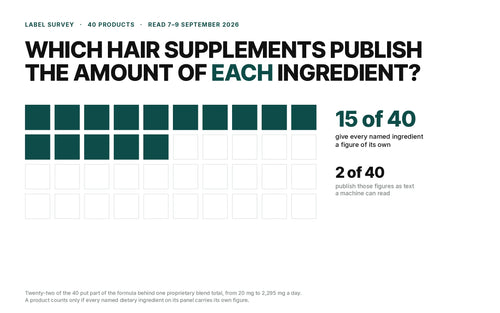
One of the 22 ingredients in our formula carries a warning we think every label at this dose should carry, and this is it. The full Supplement Facts panel, with % Daily Value, lists all 22 amounts as text; the biotin question is also answered on our FAQ page; and our audit of what eight hair-supplement labels let a buyer verify found that five of the seven biotin-containing products publish a biotin warning somewhere on their site, and two — Codeage at 10,000 mcg and Nature's Bounty at 5,000 mcg — do not. If you want to check the rest of the formula before deciding, the product page shows every amount and both AutoShip plans at their renewal prices.
What else do people ask about biotin and blood tests?
Does biotin affect blood tests?
Yes, at supplement doses. Biotin interferes with immunoassays that use biotin–streptavidin binding: sandwich assays such as troponin, TSH, NT-proBNP and hCG read falsely low, and competitive assays such as free T4, free T3, 25-hydroxyvitamin D and testosterone read falsely high. The FDA has warned about it since November 2017 and reported one death after a falsely low troponin result.
What blood tests does biotin affect?
Those run on biotin-based immunoassays, which vary by laboratory: troponin, TSH, free T4, free T3, parathyroid hormone, NT-proBNP, 25-hydroxyvitamin D, hCG, testosterone, estradiol, ferritin, PSA, thyroglobulin and vitamin B12 are named by the AACC guidance. Routine chemistry such as glucose, cholesterol, electrolytes and a complete blood count is not measured this way.
When should I stop biotin before a blood test?
The FDA gives no number. Quest Diagnostics and the AACC advise 8 hours at ordinary multivitamin doses and 72 hours at hair-supplement doses of 5 to 10 mg; the American Thyroid Association advises 2 days before thyroid tests; Cleveland Clinic advises 72 hours and names 3,000 mcg products. For BLOOHAIR MEN, at 3,000 mcg, we advise pausing for 72 hours and telling your doctor and the laboratory.
How much biotin is in BLOOHAIR MEN?
3,000 mcg per 4-capsule serving — 100 times the 30 mcg Daily Value, printed as text with the percentage (10,000%) on the product page and the Supplement Facts page. It is the same amount as Nutrafol Men's label shows (read 5 September 2026), and it is a category dose, not a dose established by research.
Does biotin help hair growth?
Not in people who are not deficient, as far as the evidence goes. The NIH Office of Dietary Supplements describes the support for biotin and hair as "only a few case reports and small studies", with the hair case reports "only in children". Biotin corrects hair loss caused by biotin deficiency, which is rare in adults on a normal diet.
Sources and dates of reading
FDA, "UPDATE: The FDA Warns that Biotin May Interfere with Lab Tests: FDA Safety Communication", issued 28 November 2017, updated 5 November 2019 — text preserved in docket FDA-2019-D-1876 (document 0015) on regulations.gov; the fda.gov pages returned "page not found" on 6 September 2026. FDA, Biotin Interference with Troponin Lab Tests — Assays Subject to Biotin Interference, content current as of 21 June 2022. FDA, Testing for Biotin Interference in In Vitro Diagnostic Devices, guidance, October 2020. NIH Office of Dietary Supplements, Biotin fact sheet for health professionals, updated 10 January 2022. Li D. et al., AACC Guidance Document on Biotin Interference in Laboratory Tests, J Appl Lab Med, 2020. Avery G., Biotin interference in immunoassay: a review for the laboratory scientist, Ann Clin Biochem 2019;56(4):424–430, PMID 31023057. Grimsey P. et al., Population pharmacokinetics of exogenous biotin and the relationship between biotin serum levels and in vitro immunoassay interference, Int J Pharmacokinet 2017;2(4):247–256. Katzman B.M. et al., Clin Biochem 2018, PMID 30036510. Goodrum J.M. et al., Clin Chem 2023;69(7):754–762, PMID 37253044. Quest Diagnostics, clinical education FAQ 202; ARUP Laboratories, biotin page; American Thyroid Association, Clinical Thyroidology for the Public vol. 11 issue 12; Cleveland Clinic Health Essentials, "Biotin side effects". Product pages: codeage.com, naturesbounty.com, hairtamin.com, wellbel.com, viviscal.com (6 September 2026); nutrafol.com label image (5 September 2026). Nutrafol, Codeage, Nature's Bounty, HAIRtamin, Wellbel and Viviscal are trademarks of their owners; figures may have changed since the dates of reading.
Keep Reading
*These statements have not been evaluated by the Food and Drug Administration. This product is not intended to diagnose, treat, cure, or prevent any disease. This article is for informational purposes only and is not medical advice. Speak with your healthcare provider before starting any supplement, especially if you are taking medication or managing a medical condition. Biotin may interfere with laboratory tests.