Does Saw Palmetto Affect a PSA Test? What the Trials Found, and a Correction

"Does saw palmetto affect a PSA test?" is a fair question for any man over 45 who takes a hair supplement built around the extract, and it deserves a number rather than a hunch. We went looking for the number after we noticed that our own warning had none behind it. Here is what the two largest randomised trials measured, where the belief that saw palmetto masks prostate screening comes from, and what a supplement page should actually tell you before a blood draw.
Does saw palmetto lower PSA?
No, as far as the best available evidence can tell: in the CAMUS randomised, placebo-controlled trial of 369 men, serum PSA changed by a mean of 0.23 ng/mL in the saw palmetto group and 0.16 ng/mL in the placebo group over 72 weeks (p = 0.50), at doses escalated from 320 mg to 960 mg a day — "saw palmetto extract does not affect serum prostate specific antigen more than placebo, even at relatively high doses" (Andriole et al., J Urol 2013; read 7 September 2026).
CAMUS — Complementary and Alternative Medicine for Urologic Symptoms — was a North American, multicentre, double-blind trial funded by the National Institutes of Health and run between June 2008 and October 2012. It enrolled men older than 45 with moderate lower urinary tract symptoms (an AUA symptom score of 8 to 24) and randomised them to placebo or to a saw palmetto fruit extract at escalating doses: 320 mg a day for the first 24 weeks, 640 mg a day for the next 24 weeks, and 960 mg a day — three times the usual dose — for the last 24 weeks. Serum PSA was drawn at baseline and at weeks 24, 48 and 72. The primary result on urinary symptoms was published in JAMA in 2011; the PSA analysis followed in The Journal of Urology in 2013.
What the PSA analysis measured
At baseline the two groups were similar: mean PSA 1.93 ng/mL (SD 1.59) on placebo and 2.20 ng/mL (SD 1.95) on saw palmetto, p = 0.16. Over the 72 weeks the change was 0.16 ng/mL (SD 1.08) on placebo and 0.23 ng/mL (SD 0.83) on saw palmetto, p = 0.50 — no difference, and the direction was up in both arms, not down. The authors also split the men by their starting PSA and found "no differential effect on serum prostate specific antigen ... between treatment arms when the groups were stratified by baseline prostate specific antigen." That last point matters for the "masking" worry: a masking effect would be expected to show most in men whose PSA was already elevated, and it did not.
| CAMUS, 72 weeks | Placebo | Saw palmetto (320 → 640 → 960 mg/day) | p |
|---|---|---|---|
| Men randomised | 369 | — | |
| PSA at baseline, mean (SD) | 1.93 (1.59) ng/mL | 2.20 (1.95) ng/mL | 0.16 |
| Change in PSA, mean (SD) | +0.16 (1.08) ng/mL | +0.23 (0.83) ng/mL | 0.50 |
| Effect by baseline PSA stratum | No differential effect between arms | — | |
Source: Andriole GL et al., "The effect of increasing doses of saw palmetto fruit extract on serum prostate specific antigen: analysis of the CAMUS randomized trial", J Urol 2013;189(2):486–492, doi 10.1016/j.juro.2012.09.037, PMID 23253958. Abstract read via Europe PMC on 7 September 2026.

The STEP trial: one year at the standard dose
Before CAMUS there was STEP, the Saw palmetto Treatment for Enlarged Prostates trial, published in The New England Journal of Medicine in 2006. It randomised 225 men over 49 with moderate-to-severe symptoms to one year of saw palmetto extract at 160 mg twice a day — the standard 320 mg — or placebo. There was "no significant difference between the saw palmetto and placebo groups" in symptom scores, urinary flow, prostate size, residual urine volume, quality of life "or serum prostate-specific antigen levels during the one-year study" (Bent et al., N Engl J Med 2006;354:557–566). Two trials, 594 men between them, doses from the standard 320 mg to three times that, one year and 72 weeks: no effect on PSA in either.
Where does the belief that saw palmetto masks a PSA test come from?
From a prescription drug that really does lower PSA: finasteride, a 5-alpha-reductase inhibitor, reduces serum PSA "by approximately 50%" in older men with an enlarged prostate according to its FDA label — and because saw palmetto is sold as a natural version of the same mechanism, the drug's warning was carried over to the plant without anyone checking whether the plant produced the effect (FDA label for finasteride, revised July 2022; read 7 September 2026).
The finasteride label is explicit. In the Warnings and Precautions section: "in clinical studies with PROSCAR (finasteride, 5 mg) when used in older men who have benign prostatic hyperplasia (BPH), PSA levels are decreased by approximately 50%", and even at the 1 mg hair-loss dose "the mean value of serum prostate specific antigen (PSA) decreased from 0.7 ng/mL at baseline to 0.5 ng/mL at Month 12." That is a real interference, and it is why urologists ask about 5-alpha-reductase inhibitors before reading a PSA result. Saw palmetto's fatty acids inhibit the same enzyme in the test tube, so the reasoning went: same enzyme, same masking. The reasoning is tidy. The measurement disagrees with it, twice.
What we published, and why it was wrong
Our launch brief carried the sentence "saw palmetto can lower PSA values and mask a prostate cancer screening" as a warning to put on the site, and we put it on the site — on the product page, the Supplement Facts page, the FAQ, the footer disclaimer and the machine-readable agents.md file. It read as responsible. It was also unsourced, which breaks the first rule we hold everyone else to: a published figure needs a primary source, a date of reading and a denominator. When we went to add the source, we found the trials above instead. A warning that is not true is not caution; it is a different kind of misinformation, and it would have sent men to their doctors with a wrong idea about what to discount. So it is withdrawn, with today's date on every page it appeared on.
What do the NIH and cancer centres say?
The National Center for Complementary and Integrative Health, part of the NIH, states in its saw palmetto fact sheet (last updated April 2025) that "saw palmetto does not appear to affect readings of prostate-specific antigen (PSA) levels, even when taken in higher-than-usual amounts", and Memorial Sloan Kettering Cancer Center's About Herbs page (updated 16 October 2023) says that "a saw palmetto extract did not affect serum prostate specific antigen (PSA) more than placebo even at high doses" (both read 7 September 2026).
Neither page says that saw palmetto masks screening. Both are written for patients and clinicians by institutions with no supplement to sell, and both point at the same trial we do. If you take one thing from this article to your urologist, take the NCCIH sentence; it is the one a physician is most likely to accept at face value.
Does the 200 mg in BLOOHAIR MEN change the answer?
No: BLOOHAIR MEN carries 200 mg of saw palmetto extract, standardised to 45% fatty acids, per four-capsule serving — below the 320 mg standard dose in STEP and below every step of the 320, 640 and 960 mg escalation in CAMUS — and a lower dose is not a reason to expect an effect on PSA that higher doses did not produce.
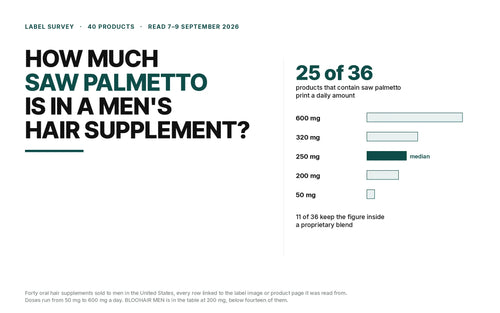
We print the amount because it is the only way a reader can place a product against the research, and this is a case where placing it is straightforward. Only 25 of the 36 saw palmetto hair supplements in our survey of 40 men's hair supplement labels, read 7–9 September 2026, print that amount at all, and only 15 of the 40 give every named ingredient on the panel a figure of its own — the full count is in which hair supplements publish the amount of each ingredient. The trials used lipidosterolic extracts at 320 mg a day and above; ours is 200 mg at 45% fatty acids. Whatever one thinks saw palmetto does for hair — and we say elsewhere that the hair evidence is smaller than the prostate evidence — the PSA question does not turn on our dose. It was answered at doses larger than ours.

What should you still tell your doctor before a PSA test?
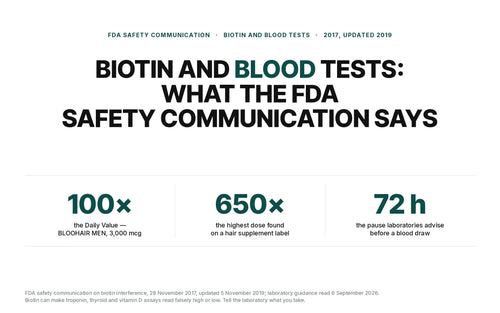
Everything you take — because two things genuinely move a PSA result and neither is saw palmetto: 5-alpha-reductase inhibitors such as finasteride and dutasteride, which roughly halve it, and high-dose biotin, which can make the sandwich immunoassays used for PSA read falsely low; BLOOHAIR MEN contains 3,000 mcg of biotin per serving, so the interference to mention to your laboratory is the biotin, not the saw palmetto.
That last point is the one we would rather you took from our own label than discover elsewhere. The AACC/ADLM guidance on biotin interference (2020) lists PSA among the sandwich immunoassays that read falsely low when free biotin is high, and the FDA's biotin safety communication tells patients to tell their physician and the laboratory that they take biotin. Our advice for a 3,000 mcg product is to pause it 72 hours before any blood draw and say so on the intake form; the full reasoning, with each laboratory's figure, is in our article on biotin and blood tests. Saw palmetto does not need to be paused for a PSA test on the evidence above; it does need to be on the list you hand your doctor, like everything else you swallow, because a physician reading a result should know what you take without having to ask.
And the part this correction does not change
Nothing here says saw palmetto is safe in every man, or that it works for hair, or that it does anything for the prostate — STEP and CAMUS found no benefit on urinary symptoms either, which is the other half of those trials. It says one narrow thing: two randomised trials, 594 men, up to 960 mg a day, no effect on serum PSA. Our Supplement Facts page now says that, with the same numbers and the same date, and the product page shows the corrected warning next to the 200 mg it applies to.
What else do people ask about saw palmetto and PSA?
Does saw palmetto lower PSA?
Not measurably. In the CAMUS randomised trial (369 men, 72 weeks, up to 960 mg a day) PSA rose by a mean of 0.23 ng/mL on saw palmetto and 0.16 ng/mL on placebo, p = 0.50; in the STEP trial (225 men, one year, 320 mg a day) there was no difference in PSA between saw palmetto and placebo. The NIH's NCCIH says saw palmetto "does not appear to affect readings of PSA levels, even when taken in higher-than-usual amounts."
Can saw palmetto mask prostate cancer on a PSA test?
The trials give no support for that. Masking would require PSA to fall on saw palmetto, and in CAMUS it did not fall — in either arm, or in the men whose PSA was already elevated at baseline. The drug that does lower PSA, by about half, is finasteride; the caution belongs to it.
Should I stop saw palmetto before a PSA test?
On the evidence, there is no PSA reason to. Tell your doctor you take it, as you would any supplement. If your product also contains biotin at hair-supplement doses, that is the ingredient to pause before a blood draw, because biotin can interfere with the immunoassay used to measure PSA.
Does BLOOHAIR MEN affect a PSA test?
Its 200 mg of saw palmetto per serving sits below every dose at which the trials found no effect on PSA. Its 3,000 mcg of biotin per serving can interfere with PSA and other immunoassays, so pause the product 72 hours before a blood draw and tell the laboratory. We corrected our earlier statement about saw palmetto on 7 September 2026.
Does saw palmetto work like finasteride?
Not in the measurements that count. Finasteride lowers PSA by approximately 50% according to its FDA label and is a prescription drug; saw palmetto did not change PSA more than placebo in two randomised trials and did not improve urinary symptoms in either. Sharing a target enzyme in the laboratory is not the same as sharing an effect in men.
Sources and dates of reading
Andriole GL et al.; CAMUS Study Group. The effect of increasing doses of saw palmetto fruit extract on serum prostate specific antigen: analysis of the CAMUS randomized trial. J Urol 2013;189(2):486–492, doi 10.1016/j.juro.2012.09.037, PMID 23253958. Barry MJ et al. Effect of increasing doses of saw palmetto extract on lower urinary tract symptoms: a randomized trial. JAMA 2011, PMID 21954478. Bent S, Kane C, Shinohara K, Neuhaus J, Hudes ES, Goldberg H, Avins AL. Saw palmetto for benign prostatic hyperplasia. N Engl J Med 2006;354(6):557–566, doi 10.1056/NEJMoa053085, PMID 16467543. National Center for Complementary and Integrative Health, Saw Palmetto: Usefulness and Safety, last updated April 2025. Memorial Sloan Kettering Cancer Center, About Herbs: Saw Palmetto, updated 16 October 2023. FDA, PROPECIA (finasteride) prescribing information, revised July 2022, section 5.2. Li D et al., AACC Guidance Document on Biotin Interference in Laboratory Tests, J Appl Lab Med 2020. FDA, biotin safety communication, 28 November 2017, updated 5 November 2019. All read 7 September 2026. BLOOHAIR MEN doses from the printed label, transcribed 1 September 2026. Nothing in this article is medical advice; a physician who knows what you take is the person to read your PSA result.
Keep Reading
*These statements have not been evaluated by the Food and Drug Administration. This product is not intended to diagnose, treat, cure, or prevent any disease. This article is for informational purposes only and is not medical advice. Speak with your healthcare provider before starting any supplement, especially if you are taking medication or managing a medical condition. Biotin may interfere with laboratory tests.